







A CEO time audit is a short, honest record of where your working hours actually go. For at least one week (ideally two or three), you track every task, switch, interruption and distraction as it happens. Then you sort what you find into what only you should do, what can be systemized, and what can be handed off. It’s the first step to getting your time back, and it takes about three minutes to start.
Every single day, I am at risk of losing my morning.
It starts innocently. A walk through whatever city we’re living in, a podcast in my ears. Or I pick up my phone to check in on family back home and end up in a scroll I didn’t plan for. News. Social. One thing leads to another.
My kids usually notice before I do. “Mom. Mom. Mom…” Or they just look at each other and laugh until I catch on.
The clock confirms it. What felt like 20 minutes was an hour and a half. The morning I planned to use? Gone. Again.
And I know better. I built an entire framework around knowing better. Which is exactly why I start every round of the Clone Yourself process the same way: with a time audit.
Why do business owners need a time audit?
Because busy does not equal productive.
The Pareto Principle says roughly 20 percent of what you do creates 80 percent of your results. So on a ten-item to-do list, about two things are actually moving the needle. The other eight feel productive. They mostly aren’t.
I call this rocking. A rocking chair is steadily, convincingly in motion. It’s comfortable. And at the end of the day it’s in exactly the same spot.
Most of us aren’t rocking because we’re lazy. We’re rocking because stopping is scary. If we slow down long enough to look at what’s on our plate, we’ll have to admit we can’t do it all. You can handle it. You’ve proven that a hundred times. But capable isn’t the same as sustainable.
The problem is that we’re terrible at remembering where our time went. We remember what felt busy, not what actually happened. A time audit replaces the guessing with data. Think of it as the clock that doesn’t lie, for your whole business.
What should a CEO spend their time on?
Here’s a quick thought experiment I use in the book.
Imagine I could blow money into the room you’re sitting in right now. For 30 seconds, $1 bills, $5 bills and $100 bills come flying in at once. Whatever you grab, you keep.
Go!
Okay, time’s up. Which bills did you go for?
You went after the $100 bills, right? Of course you did. Yet most owners spend their days wandering around picking up $1 tasks. Inbox. Formatting. Chasing a file. Fixing the thing someone else could fix.
Your $100 bill activities are the ones that generate revenue, create leverage, and let your business grow without needing more hours from you. It’s the work only you can do at the highest level. When you’re doing it, you can feel the difference.
The $1 bills? Most of them can be deleted, automated, or handed off. The time audit shows you exactly which is which.
Keep this question handy for any moment of any day: Is what I’m focused on right now a $100 bill? If not, stop. If yes, keep going.
How do I do a time audit as a business owner?
You don’t need a fancy tool. You need a commitment. Here’s the process.
1. Decide where you’ll track
A time-tracking app, a Google Doc, your calendar, a spreadsheet or a paper notebook all work. Pick the one you’ll actually stick with. The format matters far less than the habit.
2. Track every shift, not just the tasks
Write down what you’re working on and every time your attention moves: task switches, interruptions, the “quick” Slack reply, the scroll you didn’t plan. You’re after the full picture, detours included. The goal isn’t perfection. It’s awareness.
3. Give it at least one week, ideally two or three
One week gives you a snapshot. Two or three weeks show you patterns:
- What consistently drains your energy?
- What fragments your focus?
- When and where does your most valuable work actually happen?
4. Reflect and sort
Review the data and make notes while it’s fresh. Sort each recurring activity into one of three piles:
- Keep: the $100 bills that deserve more of your week, not less.
- Systemize: work that has to happen but could follow a process, a template or an automation.
- Hand off: tasks that belong with a team member, a contractor, a better tool or an AI clone.
What you end up with is your time inventory: a clear picture of how your most valuable resource is really being spent. From there, smarter decisions get a lot easier.
What will a time audit show me?
Here’s what I see again and again: most women who do this exercise don’t find laziness. They find that their workday went to everyone and everything else first.
You’ll spot the things you’ve been squeezing in around the edges that deserve a real place on your calendar. You’ll see the tasks eating hours without earning them, the interruptions that chop your day into pieces, and the work that exists out of habit rather than impact.
And underneath all of it, you’ll find the map of where systems, automations and AI can step in, and where a person or a better tool could handle things instead of you. (If you’re wondering whether you’ve become the bottleneck, this is how you find out for sure. More on that in Are You the Bottleneck?)
Should my team do a time audit too?
It can help a lot, as long as you frame it well. This is not about monitoring anyone or micromanaging. It’s a point-in-time snapshot, not a forever task on their to-do list.
Tell your team why you’re doing it, how long it will last and how you’ll use the information: to support them, not control them. When everyone can see how time is really being spent, you can work together on what to streamline and how to match work to each person’s strengths.
And if it’s just you right now? Do it anyway. Without a team pulling you in different directions, it’s easy to fill every hour with work that feels productive but isn’t. Tracking shows you what the busyness has been covering up.
How often should I do a time audit?
I track my own time two or three times a year, especially when we move to a new city or our strategy shifts. That’s when I’m most likely to lose track of my mornings. Awareness gives you an opportunity to return to intention.
Your 3-minute move: a voice memo to yourself
Not ready to commit to two weeks of tracking? Start here.
Open a voice memo. Talk through what you did today, or even just the last few hours. What did you do? What drained you? What felt like a great use of your time? Don’t edit yourself. Talk like you’re telling a friend.
That’s it. Three minutes, maybe less.
Most people don’t actually know where their time goes. They know they’re busy. But busy doing what, exactly? That memo is the beginning of your answer. Drop it into your AI tool of choice and ask it to sort your day into keep, systemize and hand off. You’ve just run your first mini time audit.
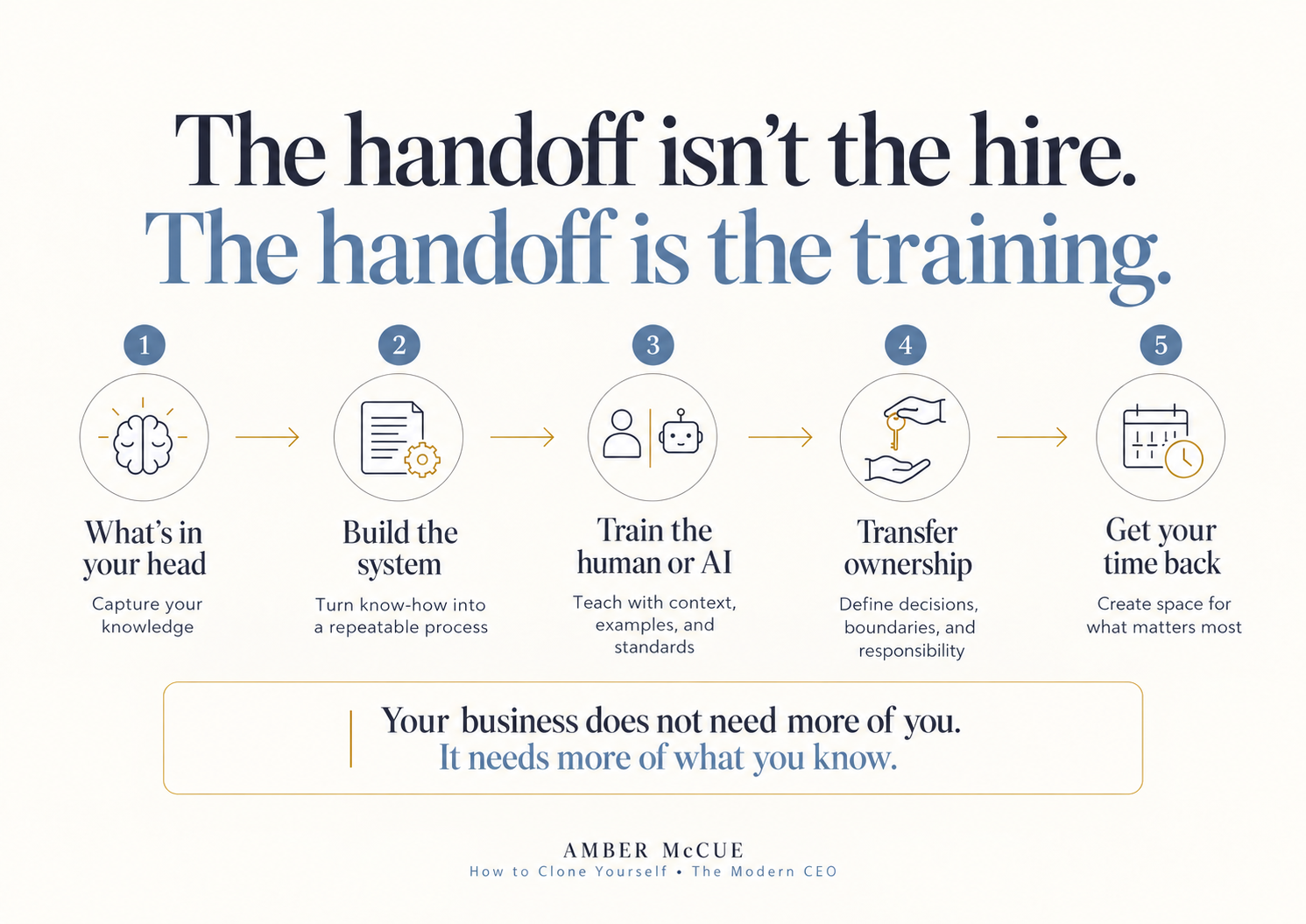
And your answer is where cloning yourself begins. Once you know where your time goes, you can finally decide where it should go. That next step, deciding what only you should do, is the first handoff, and it’s exactly what we walk through together in How to Clone Yourself.
Frequently asked questions
What is a CEO time audit?
A CEO time audit is a record of how a business owner actually spends their working hours, tracked in real time for one to three weeks. It’s used to separate high-value work from tasks that can be deleted, systemized or delegated.
How long should a time audit last?
At least one week. Two to three weeks is better, because it reveals patterns in your energy, focus and interruptions instead of one-off days.
What’s the best tool for tracking my time?
The one you’ll use consistently. A time-tracking app, your calendar, a spreadsheet, a Google Doc or a paper notebook all work. Commitment matters more than the tool.
What do I do with the results?
Sort every recurring task into keep, systemize or hand off. Protect your highest-value work, build simple systems for repeatable work, and delegate the rest to a team member, contractor, tool or AI assistant.



Read the Comments +